
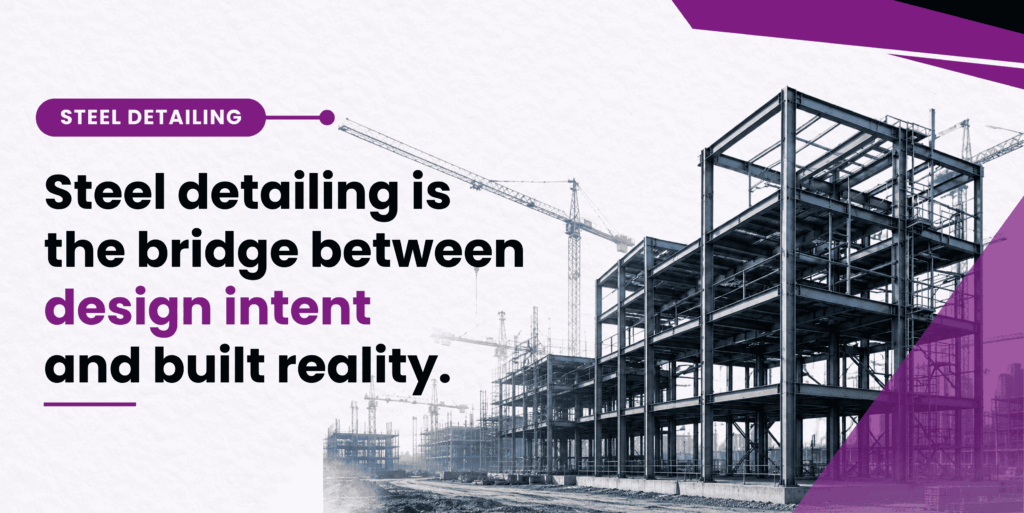
Steel Detailing Is The Bridge Between Design Intent And Built Reality
June 29, 2026
01. What It Is?
Steel detailing is the process of translating an engineer’s design into fabrication and erection documents that the supply chain can directly act upon, commonly known as shop drawings.
A well prepared set of shop drawings provides clear and actionable information, including:
- Interpretation of the original design intent
Exact member sizes and their placement
Detailed weld, bolt and connection specifications
Erection sequencing and fit up clarity
Accurate dimensions that guide fabrication precision
In construction, there is no room for assumptions especially in complex or high risk structures.
When detailing is poor, vague or inconsistent, assumptions increase. This often leads to rework, delays and disputes on site.
In contrast, when detailing is precise, well aligned and properly coordinated, all project stakeholders work from a single, reliable source of truth, ensuring smoother execution and higher quality outcomes.
02. BIM Shift
In modern construction, the model is now the product. Traditional drawings are increasingly generated directly from the digital model, eliminating manual transcription errors and improving overall consistency across project stages.
1. The Future of Steel Detailing is Intelligence + Integration
With the rise of digital twins, automation and BIM integration, steel detailing is evolving into a more advanced and connected discipline. It is becoming:
More collaborative
More data driven
More integrated with project controls
More predictive in identifying and analyzing risks
However, these advancements do not replace steel detailers. Instead, they enhance their role by enabling greater accuracy, efficiency and decision making capability.
2. Enhancing Efficiency with BIM in Steel Construction
Efficiency in construction projects is often constrained by repeated adjustments, coordination challenges and the need for detailed planning. BIM helps streamline and accelerate these processes in several ways:
Automated fabrication data: BIM models can generate CNC (Computer Numerical Control) data that feeds directly into machines, enabling faster and more accurate steel fabrication.
Integrated project coordination: BIM creates a collaborative environment where engineers, architects and fabricators can resolve issues in real time, reducing delays caused by miscommunication and rework.
3. Innovations in Steel Fabrication Enabled by BIM
Steel fabrication technology has advanced significantly alongside BIM, integrating tools such as CNC machines, laser cutting systems and even 3D printing technologies. When combined with BIM workflows, these innovations create a seamless transition from design to construction.
Direct to fabrication workflow: BIM models can now directly drive CNC machines, removing the need for manual interpretation of drawings and significantly reducing the risk of errors.
03. CNC Ready
DSTV files can be transferred directly from the digital model to CNC machines, eliminating the need for manual programming and reducing the risk of dimensional errors or misinterpretation.
DSTV (Deutscher Stahlbau-Verband) is the standard NC format used in structural steel fabrication. It is widely supported by major fabrication machines such as Ficep, Peddinghaus, Voortman, Kaltenbach, Ocean and others, making it a universal bridge between design and production.
In this workflow, different file types serve specific purposes. NC1 files are used for beam type members and contain complete machining data, including hole locations, bolt patterns, cope cuts, weld preparations and scribing marks. These files allow beam drill lines to execute operations directly without manual setup.
For plate work, DXF files are used for CNC cutting of base plates, gusset plates, end plates and other custom profiles, enabling precise fabrication on plasma and waterjet cutting machines.
Additional formats such as KISS files and other machine specific outputs are also used depending on fabrication shop requirements and equipment compatibility.
Each file is typically linked to its corresponding piece mark and drawing number through structured naming, ensuring clear traceability across the fabrication process.
04. Steel Detailing: The First Line of Clash Prevention
Steel detailing is often the first practical stage where potential clashes become visible and can be resolved before construction begins.
Common clash points include:
Architectural soffits
Masonry walls
Ceiling and façade elements
Staircases and elevators
Anchor bolt layouts
Bracing intersections
Crane clearances
Experienced detailers are often able to identify these issues even before formal BIM clash detection is run.
Early detection helps maintain project efficiency and coordination. Late detection, on the other hand, typically leads to costly rework, delays and on site complications.
05. The 6 Core Deliverables
A complete steel detailing package typically includes the following key outputs:
3D BIM Coordination Model: A coordinated 3D model used to identify and resolve clashes, connection issues and constructability challenges before fabrication begins.
Fabrication Drawings: Detailed shop drawings containing dimensions, member information, welds and bolt specifications required for accurate fabrication.
Erection Drawings: Clear site installation drawings showing member locations, assembly sequence and erection guidance for efficient on site execution.
CNC & Fabrication Files: Machine ready CNC data and related fabrication files that support automated cutting, drilling and production workflows.
Material Take-Off (MTO): Accurate quantity extraction of steel members, plates, bolts and accessories for procurement and cost control.
Fabrication & Field Reports: Supporting reports used for tracking fabrication progress, quality checks, erection coordination and project monitoring.
Results Achieved
Zero fabrication rework due to early clash detection
30% reduction in drawing approval time through coordinated 3D model reviews
Accurate CNC data generated directly from the BIM model
Seamless coordination between design, fabrication and erection teams
This approach demonstrates how BIM based steel detailing integrates design accuracy, fabrication efficiency and site execution into a single, streamlined workflow.
06. Why AISC and NISD Standards Matter in Steel Detailing?
Steel detailing is not just about drawings – it is about producing accurate, coordinated and standards compliant fabrication and erection information based on AISC and NISD guidelines.
When Standards Are Not Followed
Without proper standards, even small detailing issues can lead to major problems such as:
Incorrect or missing connection details
Inconsistent marking and numbering
Misaligned bolt holes and weld specifications
Inaccurate dimensions and unclear drawings
Clashes between disciplines and design intent
Result: RFIs, rework, fabrication delays, material waste and costly site errors that are often discovered too late.
When Standards Are Followed
Following AISC and NISD ensures:
Consistent and accurate drawings
Proper member identification and detailing
Correct bolt, weld and connection information
Reliable BOM and controlled documentation
Result: Faster fabrication, fewer errors, reduced rework, smoother erection and better coordination between all project teams.
Conclusion -
By following AISC and NISD standards and leveraging BIM driven workflows, up to 99% of connection conflicts can be identified and resolved before fabrication and erection. The quality of steel detailing directly determines the quality of the project. Every connection, every bolt and every member must be accurately defined and verified before steel is cut.